The Most Dangerous Word in Small Business: Discount
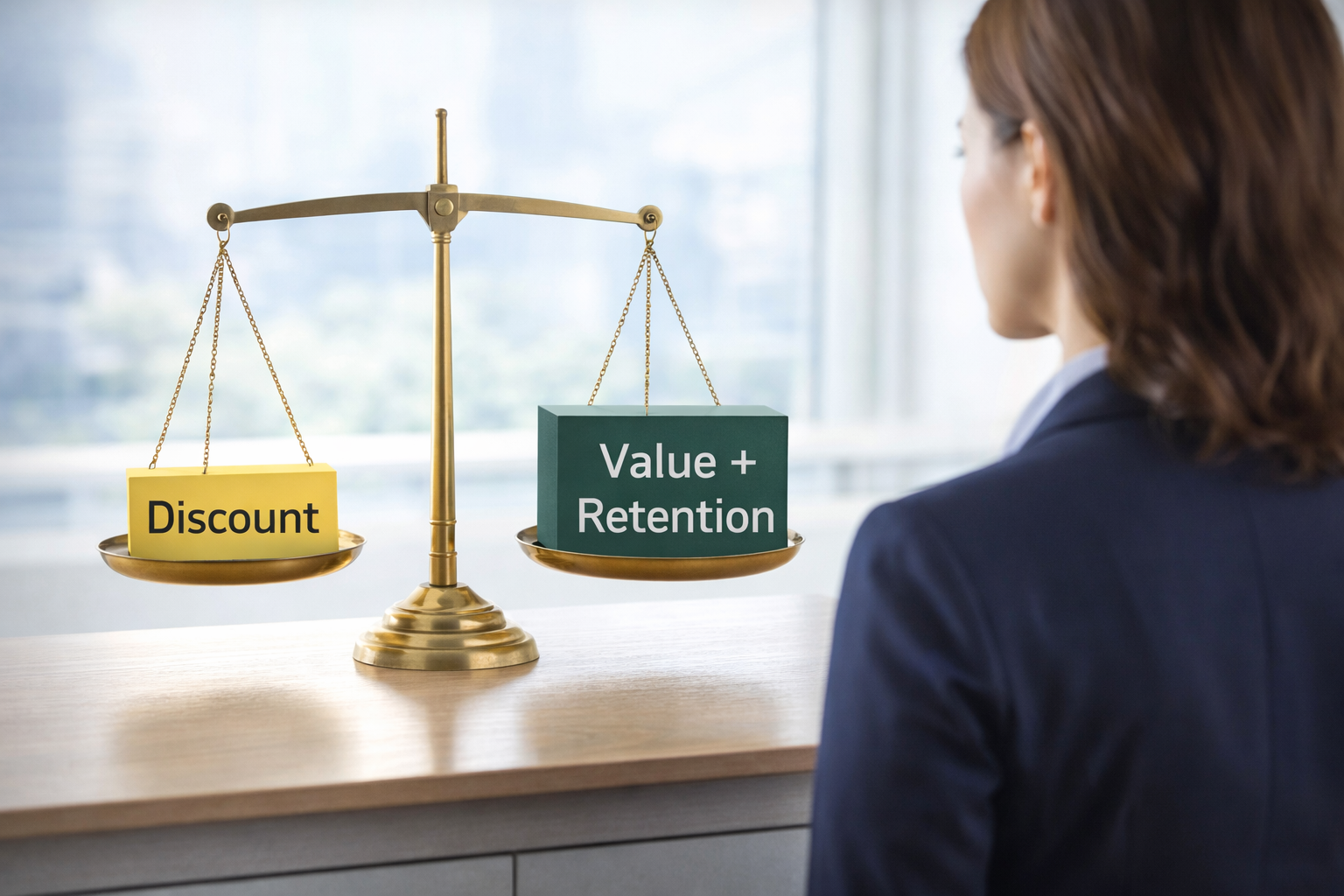
When sales slow down, the most common reaction in small businesses is simple: offer a discount. It feels like action. It feels like growth. But very few owners stop to calculate what that discount is really costing them. In reality, discounting is not a marketing strategy — it is a margin decision. And without understanding profit per service, customer lifetime value, and contribution margin, many businesses reduce their earnings while believing they are increasing sales. Before lowering prices, it’s worth asking a more important question: do you actually know your real profit?
Discounting Is Not a Strategy.
It’s a Margin Decision.
The most dangerous word in small business is not “competition.”
It’s “discount.”
When sales slow down, many business owners react the same way:
“Let’s run a promotion.”
“Let’s offer 10% off.”
“Let’s attract more customers with lower prices.”
It feels like action.
It feels like growth.
But very few stop to calculate what they are actually giving away.
Revenue Is Not Profit
Most small businesses track:
- Monthly revenue
- Number of customers
- Cash flow
But they rarely track:
- Profit per service
- Contribution margin
- Customer lifetime value
- Cost of acquisition
And without those numbers, discounting feels harmless.
But it isn’t.
Revenue is vanity.
Profit is survival.
The Hidden Math of a “Small” Discount
Let’s take a simple example.
Service price: 100 GEL
Cost to deliver service: 60 GEL
Profit before discount: 40 GEL
Now apply a 10% discount.
New price: 90 GEL
Cost remains: 60 GEL
New profit: 30 GEL
You reduced the price by 10%.
But you reduced your profit by 25%.
That’s not a marketing tactic.
That’s a structural margin cut.
Now ask yourself:
How many additional sales do you need to make just to earn the same profit as before?
If profit per sale drops from 40 GEL to 30 GEL,
you must sell 33% more services to earn the same total profit.
More work.
Same money.
The Psychological Cost of Discounting
Discounting does more than reduce margin.
It changes customer behavior.
Customers start to:
- Wait for promotions
- Compare only on price
- Become less loyal
- Switch more easily
You begin attracting price-sensitive customers.
And price-sensitive customers are rarely long-term customers.
Over time, your brand stops competing on value
and starts competing on cheapness.
That is a very difficult position to escape.
Why Owners Discount
Most owners don’t discount because they want to destroy margin.
They discount because they feel pressure.
- Sales are slower than expected
- Cash flow feels unstable
- Competitors are advertising aggressively
- There is fear of losing market share
Discounting feels like control.
But often, the real issue is not pricing.
It is lack of financial clarity.
The Number Most Businesses Ignore: Customer Lifetime Value
Let’s look at a common service example.
Average membership: 130 GEL per month
Average customer stays: 2.5 months
Total revenue per customer:
130 × 2.5 = 325 GEL
Now imagine instead of discounting the monthly price,
you improve retention.
If average stay becomes 6 months:
130 × 6 = 780 GEL
If you offer annual membership at 1,200 GEL:
You multiply customer value nearly 4x.
Retention increases profit without reducing price.
Discounting reduces price without increasing loyalty.
There is a fundamental difference.
Most Businesses Don’t Know Their Real Profit
Ask yourself honestly:
- Do you know profit per service?
- Do you know how much one average customer earns you over time?
- Do you know your churn rate?
- Do you know your cost per acquisition?
- Do you know which customer segment generates the most profit?
If the answer is no,
then discounting is not strategy.
It is guessing.
And guessing with margins is dangerous.
What to Measure Instead of Discounts
Instead of asking:
“How much can we reduce the price?”
Start asking:
- What is our contribution margin?
- What is our average customer lifetime?
- How can we increase retention by 1–2 months?
- How can we increase engagement?
- How can we increase upselling?
Small improvements in retention often generate more profit
than aggressive discounts.
Value Beats Price
Stronger alternatives to discounting:
- Bundled packages
- Annual commitments
- Loyalty benefits
- Subscription models
- Personalized engagement
- Better service visibility
- Easier booking and renewal
Instead of lowering price,
increase perceived value.
Customers don’t leave only because of price.
They leave because of weak engagement, low differentiation, or better alternatives.
Final Thought
Discounting is easy.
Financial discipline is harder.
But sustainable businesses are not built on promotions.
They are built on structure, margin clarity, and customer lifetime value.
If you don’t understand your real profit per customer,
every discount is a silent risk.
Before lowering your price,
calculate what you’re really lowering.
Because price can recover.
Lost margin rarely does.
Author

Shota Kvaratskhelia
Digital creator, entrepreneur, engineer